At Milkweed Arts, wool and silk partner in the ancient art of feltmaking, made new when I create one-of-a-kind designs for your personal wear, home, business, and sacred space.
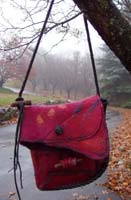

Each autumn the rough, sun-bleached milkweed pod tells its secret, bursting in white enchantment along roads and fields. I would like to make art as the milkweed does, allowing each piece to grow from an image, color, or word that has graced the path of a day. I want to let the seeds go where they will, and create something beautiful for ordinary use.
About my Feltmaking Art
Feltmaking is the art of the nomad, a life defined by journey, sustained by beauty. For thousands of years, felt-makers have used the animal fibers at hand to partner the practical with the beautiful. I look not only to this ancient guild to mentor my craft, but to the wildflower nomads that drift and spangle the New England landscape.
A fine line of prose or poetry often inspires my feltmaking. So does the speech of birch, leaf, and bee. The span from text to textile is the breadth of a hand, as it translates such everyday eloquence into designs of fine merino wool and hand-dyed silk.
“Endless returning … not farewell, but faring forth into the grace of transformed continuance … “
—Denise Levertov, “Relearning the Alphabet”
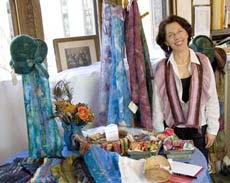
What is Felt?
 Felt is the result of the oldest known textile process, the compression of tangled fibers. Archaeologists have discovered samples of feltmaking that reach back to 6,000 BC, making it older than spinning, weaving, or knitting. The oldest fragments of felt-totemic swans, embellished saddles and hats-have been found in Central Asia, Scandinavia, and the Mideast, where nomads felted their tents, or yurts, from the fiber of pack and herd animals. Wool can even be so tightly felted that ancient warriors used it as armor.
Feltmakers depend on the miraculous way the tiny scales of wool fibers open and interlock under the right conditions-moisture, change in ph, warmth, friction, and compression. These tangled fibers create a material that gets kudos for practicality: it is durable, lightweight, warm, and water-resistant. But it is also a textile artist’s dream. The versatile stuff can be sculpted, dyed, sewn, embellished, and combined with other fabrics, such as silk and cotton.  From warm cloaks and clogs to cobweb-light scarves and curtains; from hats, bags, vests, and vessels to rugs, toys, and table runners-felt serves an endless array of purposes, all the while offering the natural beauty and benefits of wool.
 Milkweed Arts
Leave a comment